In high-stakes medical environments, a data breach isn't just a technical failure—it’s a breach of patient trust. Led by a military veteran with over 20 years of experience in healthcare, legal, and manufacturing security, Simplified Security Solutions brings a forensic level of detail to HIPAA compliance.
We specialize in transforming the 'Addressable' loopholes of the past into the Mandatory Safeguards of 2026. From SRA audits to zero-trust network hardening, we ensure Piedmont Triad healthcare providers can focus on care, while we protect their mission with military-grade precision.
In healthcare, data security is a matter of patient trust—and federal law. We provide the military-grade 'Sanitization' and network hardening required to protect your Protected Health Information (PHI) from 2026 threats.
At Simplified Security Solutions, we bridge the gap between complex HIPAA regulations and your daily clinical operations. Our veteran-led team ensures your practice meets every technical safeguard, from mandatory Risk Assessments to encrypted data redundancy, so you can focus on patient care while we secure the perimeter.
Most breaches occur because of a single misconfigured firewall or an unpatched computer system. We conduct a thorough "Reconnaissance" of your pratice's environment to identify vulnerabilities before the badguys do.
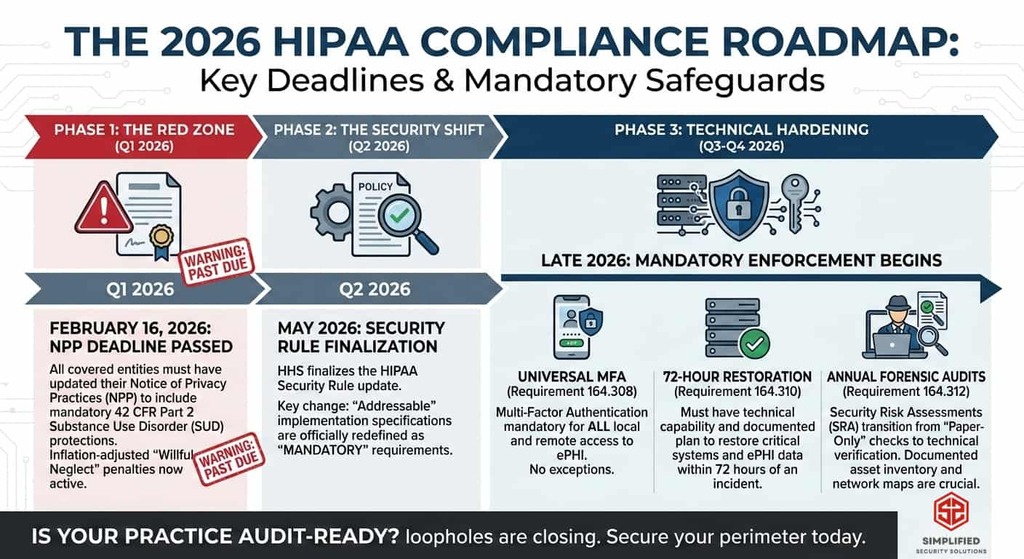
The February 16, 2026, HIPAA deadline for the Notice of Privacy Practices (NPP) overhaul has already passed.
If your notice has not been updated to include the mandatory 42 CFR Part 2 alignment for Substance Use Disorder (SUD) records, your practice is currently out of compliance and at risk for inflation-adjusted civil penalties.
Free 15-minute perimeter check. No PHI access required.
We take the guesswork out of the SAQ. Our team handles the technical heavy lifting:

A typical secure, HIPAA compliant server rack.
A free tactical roadmap to zero non-compliance fees.
The 2026 HIPAA update is the most significant change in healthcare security in a decade. We break down the mandatory encryption standards, the 72-hour restoration rule, and the new NPP requirements in our latest briefing.
A short, 10-minute read to help you get a handle on the the new 2026 SRA.
A free guide to 2026 HIPAA Compliance.
In the 2026 regulatory landscape, a 'static' risk assessment is a liability. The Office for Civil Rights (OCR) now prioritizes continuous compliance. Our NIST-aligned Security Risk Assessment (SRA) doesn't just identify gaps—it builds a forensic roadmap for your practice. We analyze every endpoint, from your local server rack to the tablets in your exam rooms, ensuring your technical safeguards are documented, tested, and ready for a federal audit.

A HIPAA Security Risk Assessment (SRA) is a required evaluation that all healthcare organizations must conduct in order to identify vulnerabilities and ensure compliance with the HIPAA Security Rule This assessment helps organizations ensure confidentiality, integrity, and availaility of Protected Health Information (PHI).
The Department of Health and Human Services (HHS) has officially modernized the HIPAA Security Rule. "Addressable" specifications are a thing of the past. If your practice is still relying on a static, once-a-year paper checklist, you are currently in a state of Willful Neglect.
As of 2026, a valid SRA must prove:
In 2026, most healthcare practices prefer a third-party consultant because it provides the "unbiased objectivity" that federal auditors look for. Certainly, having an outside oppinion from a security-focused vendor is a value to your practice that can free up employee time to focus on more important things, like providing outstanding patient care. Simplified Security Solutions is more than just a third-party consultant, we like to think of you as our patient. Our practice is to make your network as healthy as possible so it doesn't get sick with a virus, and if it does get sick, we want it to get better as quickly as possible.
A mandatory annual audit of how your practice handles electronic patient data. It identifies vulnerabilities in your perimeter to ensure audit readiness.
Yes. If a vendor touches your patient data, HIPAA requires a signed BAA. We provide this to ensure legal accountability for your security.
Yes. The 2026 updates require encryption for data at rest and in transit. Unencrypted data loss is now an automatic, high-fine breach.
Digital locks like MFA, unique user IDs, and auto-logoffs. we deploy these so you can focus on patients, not password security.
Under the 2026 update, technical safeguards (like MFA and encryption) are mandatory for every system that touches ePHI. This includes your local workstations, server racks, cloud-based EHR/EMR platforms, backup drives, and even mobile devices used for work communication. If the device can create, receive, maintain, or transmit patient data, it must be hardened and tracked in your annual asset inventory.
Yes. HIPAA Physical Safeguards (Requirement 164.310) mandates that you limit physical access to electronic information systems. Cameras are the industry standard for 'Facility Access Control.' You must monitor entrances, exits, and server areas, and the 2026 guidelines suggest maintaining that footage for at least 90 days to assist in potential breach forensics. As a security veteran, I don't just look at your firewall—I look at your entire perimeter. We help ensure your physical surveillance and digital network work in tandem to meet these federal standards.
Yes. Under the 2026 HIPAA Physical Safeguards, 'Facility Access Control' is no longer a suggestion—it is a mandatory audit point. Any individual not part of your formal workforce—including delivery personnel, cleaning crews, and especially IT contractors—must be identified and logged.
For high-sensitivity areas like server rooms or network closets, a standard front-desk guest book isn't enough. You must maintain a specific Access Validation Log that records the name, organization, time of entry/exit, and the authorized staff member who escorted them. In a 2026 forensic audit, these logs are the only way to prove that your physical 'Chain of Custody' remained unbroken.
A common misconception is that the February 2026 'SUD Rule' only applies to addiction clinics. This is incorrect.
If your practice receives a referral, a lab result, or a care coordination summary that contains data originating from a federally assisted Substance Use Disorder (SUD) program, you are legally required to provide 'Enhanced Notice' under 42 CFR Part 2. Because these records move through integrated care models and Health Information Exchanges (HIEs), nearly every provider in North Carolina now 'maintains' this data.
As of February 17, using an outdated Notice of Privacy Practices is a Tier 3 'Willful Neglect' risk, with inflation-adjusted penalties now starting at $14,602 per violation. We help you remediate this immediately by auditing your NPP and hardening your intake workflows.
No. Automated scans (like our deep-scans) only cover the 'Technical Safeguards.' HIPAA also requires 'Administrative' and 'Physical' safeguards. We provide the full trifecta: technical hardening, physical facility audits, and the mandatory 2026 Security Risk Assessment (SRA) required for federal compliance.
If you’re still using a paper sign-in sheet at the front desk, ensure it has a security 'slider' or 'blackout' film. If the next visitor can see the name of the patient or vendor who signed in before them, you have just committed an incidental PHI disclosure violation. We recommend digital check-in systems that instantly encrypt visitor data and alert your security team.

A typical medical facility sign in kiosk at the front desk.
No strings attached 15-minute assessment.
HIPAA compliance requires more than just administrative paperwork; it demands rigorous technical safeguards for Protected Health Information (PHI). Our free HIPAA Technical Safeguards Framework provides the forensic-first roadmap needed to audit your encrypted storage, verify access controls, and secure your "Digital Vault." Submit your request below to initialize your technical audit.
Based in the Piedmont Triad, we provide on-site security consulting and managed defense for the most regulated industries in the state. Don’t leave your HIPAA compliance to chance. Reach out today for a consultation with a 20-year security veteran. Let’s ensure your data remains impenetrable.
Confidentiality Notice: As a veteran-owned firm, we handle all inquiries with strict military-grade discretion.