
Led by a 20-year veteran of high-stakes security, Simplified Security Solutions hardens the digital perimeters of NC finance, retail, manufacturing, and healthcare providers. We don’t just manage IT; we protect your mission with military-grade precision and proven audit-readiness expertise.
Your customer’s financial data is the primary target for modern cyber-insurgents. We deploy the PCI DSS 4.0.1 'Vault' protocols necessary to secure your payment lifecycle and eliminate high-risk vulnerabilities.
Compliance isn't just a checklist; it's your business’s frontline defense against catastrophic financial loss. We specialize in hardening Point-of-Sale (POS) systems and segmenting payment networks to ensure your merchant status remains secure and your customer data stays impenetrable.
Most breaches occur because of a single misconfigured firewall or an unpatched POS system. We conduct a thorough "Reconnaissance" of your payment environment to identify vulnerabilities before the insurgents do.
Review your 4.0.1 readiness. Zero downtime required.

We take the guesswork out of the SAQ. Our team handles the technical heavy lifting:
A typical retail back office with PCI compliant network.
A free tactical roadmap to zero non-compliance fees.
Is your current firewall configuration 4.0.1 ready? Don’t wait for a non-compliance fee to find out. Get the answers to the most common PCI hurdles below.
A quick 10-minute read to help you get a handle on your compliance needs.
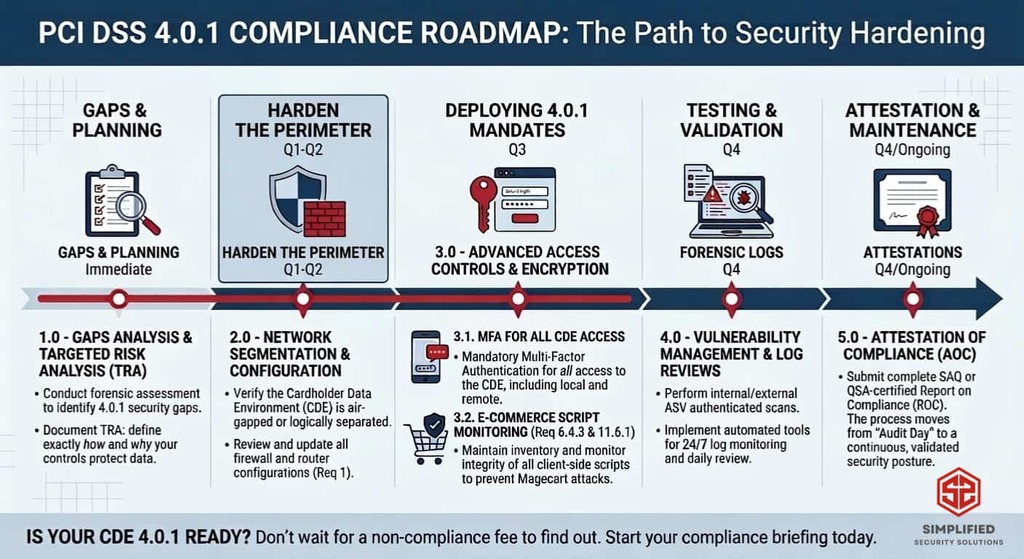
A free timeline guide to 2026 PCI Compliance
A common misconception is that using a third-party processor like Square or Stripe eliminates your risk. In reality, security is a partnership: while they secure the transaction, we secure your perimeter.
Think of your cybersecurity like a high-performance engine. You wouldn't skip the maintenance schedule and expect it to survive a cross-country trip. If one minor component fails undetected, it’s only a matter of time before the entire system fails. Don't wait for an audit to discover a "check engine" light you could have addressed months ago.
| Security Task | Handled By |
|---|---|
| Card Data Encryption | Square/Stripe |
| Merchant ID Management | Square/Stripe |
| Website & Network Hardening | Simplified Security Solutions |
| MFA & Access Controls | Simplified Security Solutions |
| Annual SAQ Validation | Simplified Security Solutions |
Identify undetected vulnerabilities before your next audit.
Network segmentation reduces the scope of your Cardholder Data Environment (CDE), but more importantly, it stops lateral movement dead in its tracks. Most businesses run a flat network, meaning a compromised smart thermostat or a guest phone on the Wi-Fi can see and talk to the credit card terminals.
By building strict, logically isolated boundaries (VLANs) and enforcing stateful firewall drop rules, we ensure that even if your corporate LAN or guest network is breached, an attacker is mechanically locked out of the environment where payment data actually lives."
PCI DSS 4.0.1 is the latest mandatory standard (active as of 2025). It shifts the focus from 'point-in-time' compliance to 'continuous security,' requiring more robust multi-factor authentication (MFA) and stricter password protocols. We help NC businesses transition to these new standards without disrupting operations.
If you accept, store, or transmit credit card data, the answer is yes. Even if you use a third-party processor, you are responsible for the 'Security of the Cloud.' We specialize in helping small to mid-sized firms in Charlotte and Wilmington navigate the Self-Assessment Questionnaire (SAQ) to avoid non-compliance fines.
Network segmentation reduces the scope of your Cardholder Data Environment (CDE), but more importantly, it stops lateral movement dead in its tracks. Most businesses run a flat network, meaning a compromised smart thermostat or a guest phone on the Wi-Fi can see and talk to the credit card terminals.
By building strict, logically isolated boundaries (VLANs) and enforcing stateful firewall drop rules, we ensure that even if your corporate LAN or guest network is breached, an attacker is mechanically locked out of the environment where payment data actually lives.
Multi-Factor Authentication is a security protocol that requires a user to provide at least two independent forms of identification before granting access. To be PCI-compliant, these factors must come from two different categories:
In the past, MFA was only required for remote access or administrators. Under the current PCI DSS 4.0.1 requirements, MFA is now mandatory for all access into the Cardholder Data Environment (CDE). This includes: Cloud Environments: Administrative portals for AWS, Azure, or hosting providers.
Not entirely. While Square and Stripe are PCI Level 1 Service Providers that handle the encryption of card data, you are still responsible for the security of the environment that touches those tools.
With Square: Square typically acts as the 'Merchant of Record,' meaning they handle the bulk of the compliance for you. However, you are still responsible for physical security (protecting your card readers) and account security (MFA and strong passwords).
With Stripe: Stripe reduces your 'scope' significantly, but you are still required to complete an annual Self-Assessment Questionnaire (usually SAQ-A) to prove that your website and business processes are secure.
Yes. Under PCI DSS Requirement 9, businesses that handle physical credit cards or host server equipment must maintain strict physical access controls. This includes the use of video cameras (CCTV) or other electronic sensors to monitor 'sensitive areas.'
To meet the requirement, your camera system must:
As a security veteran, I don't just look at your firewall—I look at your entire perimeter. We help ensure your physical surveillance and digital network work in tandem to meet these federal standards.
A Magecart attack is like a digital skimmer; it’s a malicious script that 'listens' as your customer types their credit card info and sends it to a foreign server. Requirement 11.6.1 was created specifically to stop this. We help you deploy Header Monitoring and Script Baselines so that if a single unauthorized line of code appears on your checkout page, you get an alert before the first card is even stolen.
Most providers run a 'surface-level' scan that only looks for known software bugs. We take a forensic approach. By utilizing Deep-Scan Diagnostic Tools, we go beyond the perimeter to identify 'Shadow IT,' unencrypted data at rest, and unauthorized user permissions that standard scanners miss.
We then pair this internal intelligence with Official ASV Validation to automate your mandatory quarterly external scans. You get a 'Clean Audit' report ready for your bank, backed by a 24/7 hardening strategy that prevents breaches before they trigger an alert.
We are not a QSA firm, and that is a strategic advantage for our clients. We act as your Technical Advocate. While a QSA identifies gaps once a year, we work year-round to close those gaps. We perform the forensic hardening, network segmentation, and log management required so that when your QSA arrives, you pass with zero non-compliance fees.
No jargon. Just a tactical roadmap to compliance.
Our free PCI-DSS 4.0.1 resource provides the framework needed to vet hardware origins and neutralize unauthorized telemetry. Submit your request below to access the checklist and begin your hardware integrity validation.
Based in the Piedmont Triad, we provide on-site security consulting and managed defense for the most regulated industries in the state. Don’t leave your PCI compliance to chance. Reach out today for a consultation with a 20-year security veteran. Let’s ensure your data remains impenetrable.
Confidentiality Notice: As a veteran-owned firm, we handle all inquiries with strict military-grade discretion.